Skip to content
Dense young forest canopy at 18 months — Gardenia Eco Forestry restoration

About Gardenia Eco Forestry

Ecological restoration infrastructure for India's future.

We restore degraded land into ecologically functional native forests through high-density, biodiversity-driven afforestation. The work is not decorative landscaping. It is soil repair, canopy creation, wildlife return, and long-term climate resilience made visible on the ground.

200+

Native species, 360+ varieties

10+ acres

Restored or under restoration

200k+

Plants across all projects

Why we exist

India does not need more green decoration. It needs living systems that work.

Across Indian cities and peri-urban edges, heat islands are intensifying, groundwater is declining, soils are compacted, and native habitats are being replaced by lawns, exotic ornamentals, and landscapes that consume resources without supporting life.

Gardenia Eco Forestry began from the realization that conventional landscaping cannot solve ecological problems. A garden may look green and still be biologically poor, water dependent, and fragile. Real restoration has to rebuild relationships between soil, roots, fungi, insects, birds, water, and people.

Our response is to create living carbon sinks, cool urban microclimates, improve infiltration, rebuild native biodiversity, and turn damaged land into ecosystems that become stronger with time.

Ecological philosophy

We design forests as relationships, not collections of trees.

Principle 01

Forests are living systems

A functioning forest is canopy layering, soil microbiology, root exchange, fungi, insects, birds, water movement, decomposition, and succession. We restore ecological relationships so a site can begin behaving like a forest, not merely looking like one.

Principle 02

Biodiversity creates resilience

Monocultures fail because they simplify life. Native diversity improves drought response, pest balance, climate adaptation, and long-term stability. Our species palettes can range from 120+ to 200+ species (360+ varieties) where the site, region, and ambition support that depth.

Principle 03

Density accelerates regeneration

Miyawaki-inspired density uses competition, shade, root interaction, and biomass generation to accelerate canopy formation. When applied carefully, dense planting can reduce evaporation, improve soil structure, and move degraded ground toward ecological function faster.

Principle 04

Restoration must be regional

India is not one ecology. Gujarat differs from Kerala; dryland systems require different logic than monsoon forests. We adapt restoration strategy to rainfall, soil, hydrology, heat, local genetics, and the native ecological memory of each place.

A necessary distinction

Landscaping decorates land. Restoration rebuilds its ability to support life.

Many clients come to us after realizing that a manicured green surface is not the same as ecological value. The difference matters for maintenance, biodiversity, water, heat, and long-term asset quality.

Conventional landscaping

  • Decorative planting selected primarily for appearance.
  • Frequent use of exotic species, turf, and ornamental repetition.
  • High maintenance, pruning, replacement, and irrigation dependency.
  • Low habitat value for pollinators, insects, birds, and soil life.
  • Short-term visual performance prioritized over ecological function.

Ecological restoration

  • Functional native ecosystems designed around soil, water, and succession.
  • Diverse regional species that support wildlife and climate resilience.
  • Maintenance that tapers as canopy, mulch, and root systems mature.
  • Soil building, carbon storage, cooling, infiltration, and habitat creation.
  • Long-term landscape value measured in ecological performance.

Field before formation

The practice was shaped in soil before it became a company.

Our credibility comes from doing the work: small experiments, survival observations, species trials, failed assumptions, irrigation lessons, and large-scale restoration exposure on degraded land.

Early experiments

Small native gardens and Miyawaki trials

Early work tested soil preparation, dense spacing, native species compatibility, watering behavior, and survival response in real conditions rather than ideal presentations.

Scale learning

10+ acres, 200,000+ plants, 200+ species

Large restoration experience on flood-prone, degraded land revealed what changes when biodiversity, hydrology, nursery logistics, labor rhythms, and maintenance systems meet at scale.

Lessons carried forward

Adaptation is more useful than perfection

Some species adapt faster. Some soils respond slowly. Some sites demand different irrigation tapering, mulching, or protection. Those lessons make our present work more honest, measurable, and resilient.

Impact and results

Ecological restoration is measurable infrastructure.

A restored ecosystem should not be judged only by photographs. It should be tracked through survival, canopy closure, temperature change, infiltration, biodiversity return, soil improvement, and carbon accumulation.

Cooler

Canopy and shaded soil reduce surface heat and improve outdoor comfort.

Wetter soils

Mulch, roots, and soil structure improve infiltration during monsoon pulses.

More life

Pollinators, insects, birds, frogs, bats, and reptiles indicate system recovery.

Stored carbon

Dense biomass and soil regeneration create long-term carbon capture potential.

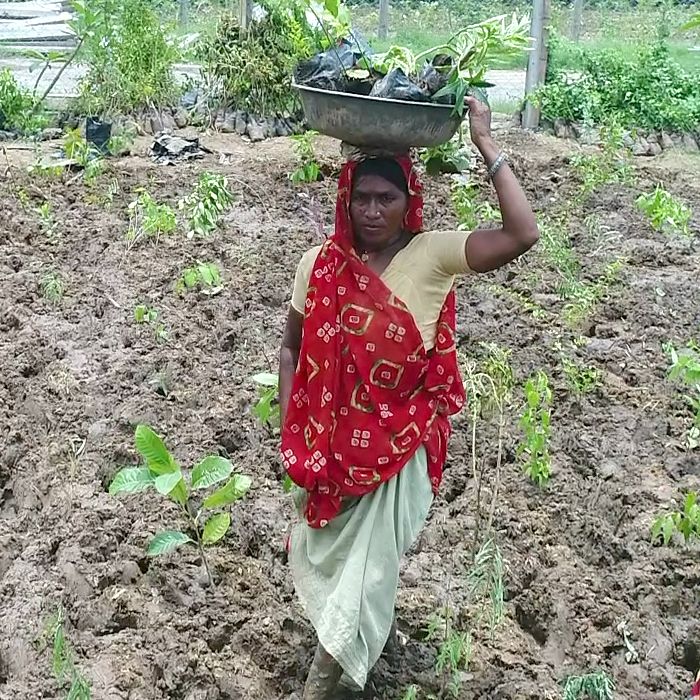
Field work during high-density native plantation

Wildlife return

When the system works, life begins to arrive without invitation.

The return of peacocks, bee-eaters, frogs, bats, insects, and pollinators is not ornamental. It is evidence that food webs, shelter, moisture, and seasonal rhythms are beginning to reconnect.

Founder

Science-led from the start.

Gardenia Eco Forestry was founded by Prayag Amin, a researcher by training with degrees in Molecular and Cellular Biology and Chemistry. That background shapes how the studio approaches afforestation — not as landscaping, but as an applied science: soil microbiology, species interactions, canopy dynamics, and ecosystem succession studied before a single sapling goes in.

The 616-species library on this site is a product of that research instinct. Every species was sourced, cross-referenced against IUCN conservation data, GBIF occurrence records, and regional phenology — not picked from a nursery catalogue. The depth of that data is what makes Gardenia's species matrices and compliance documentation credible to CSR boards and auditors.

Based in Gandhinagar, Gujarat — part of the Ahmedabad metropolitan region — the studio implements directly — not as consultants handing off to contractors, but as a team that plants, monitors, and maintains the forests it designs. For companies considering direct implementation of CSR afforestation without an agency, Gardenia serves as the implementation vendor under Rule 4(1).

Long-term vision for India

A network of native forests, ecological campuses, oxygen parks, and regenerative estates.

We see degraded urban and peri-urban land becoming biodiversity corridors that cool neighborhoods, buffer flooding, and reconnect people with regional ecology.

We see institutions treating forests as climate infrastructure: measurable, stewarded assets that improve air, water, temperature, biodiversity, and human well-being.

We see CSR foundations, corporate campuses, schools, and institutions moving beyond display toward living systems capable of educating the next generation.

Manifesto

The forests we plant today will outlive us.

Our responsibility is not simply to landscape land, but to restore living systems capable of supporting future generations. Every restored ecosystem becomes a long-term investment in climate resilience, biodiversity, and human well-being.