
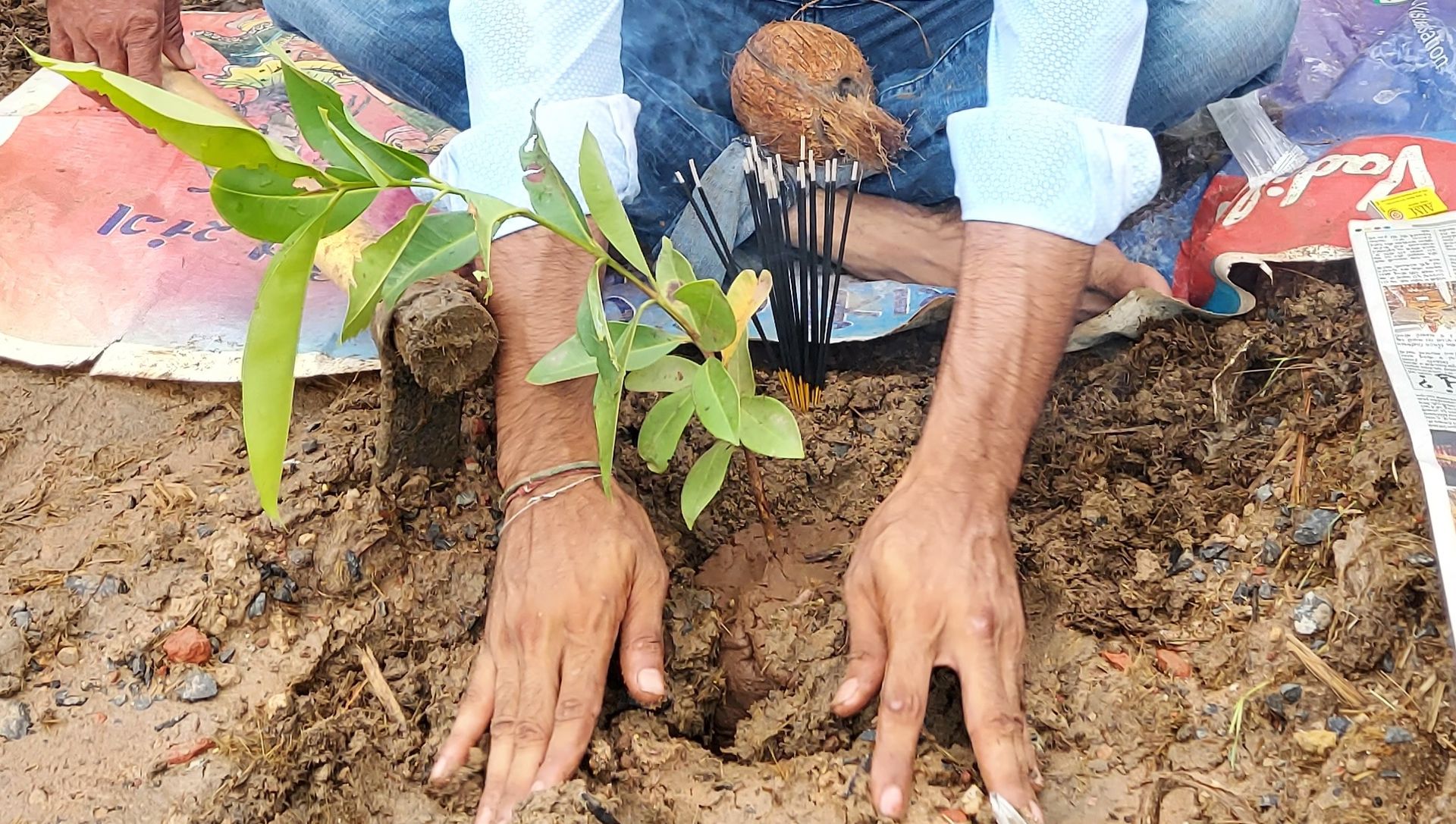
The Miyawaki method is not a planting style — it is a reconstruction of the native forest ecosystem that would grow on a site if left to nature, compressed into decades instead of centuries. Developed by Japanese botanist Akira Miyawaki, it has been applied across 3,000+ sites worldwide. Here is how it works, step by step, as we practise it on Gujarat sites.
Most plantation drives fail for predictable reasons: wrong species, dead soil, no aftercare. The Miyawaki method addresses each failure point in a fixed sequence. Skip a step and the forest pays for it later — usually in survival counts at the second monsoon.
What the Miyawaki method actually is
Akira Miyawaki, a Japanese botanist, spent his career studying how natural forests regenerate. His central insight: the species mix of a mature native forest is not random — it is the potential natural vegetation of that specific soil and climate. Plant that mix, densely, in healed soil, and the forest assembles itself far faster than conventional plantation allows.
Three principles separate the method from a regular tree-planting drive:
- Native polyculture, not monoculture. Dozens of species that naturally co-occur in the region, planted together — not a single fast-growing species in rows.
- Extreme density. Roughly 30x conventional plantation density (~3,000 saplings per acre on our Gujarat sites). The crowding is deliberate: saplings race for light, thickening trunks and canopy in 2–3 years instead of 20.
- Multi-layer structure. Canopy, sub-canopy, shrub, and herb layers established together, so the forest functions as an ecosystem from year one — shade, leaf litter, soil biology, and habitat develop simultaneously.
The result is a self-sustaining native forest that typically needs active maintenance for only the first 24 months. After that, the ecosystem cycles its own water, nutrients, and regeneration.
Step 1: Site analysis
Every Miyawaki project starts with reading the land before touching it. We map soil texture and compaction, drainage and water table, sunlight pattern through the year, existing vegetation, and the surrounding habitat pressure — what seed sources, grazing animals, and human traffic the site will face.
On Gujarat sites this step carries extra weight. Ahmedabad-region soils range from heavy clay to degraded saline patches, summer temperatures cross 42°C, and rainfall concentrates in a single monsoon pulse. A species list that works in Kerala dies here. The site analysis determines the entire species palette, the soil treatment plan, and the irrigation design — so errors made here surface for years.
Step 2: Soil rehabilitation
Most project sites are not forest soil — they are compacted, biology-poor fill or farmland exhausted by years of chemical input. Miyawaki forests grow fast because the soil is repaired first, not because saplings are magic.
Rehabilitation loosens compaction by deep aeration, then rebuilds the soil food web with organic matter, microbial inputs, and thick mulch. The target is soil that holds moisture through the dry months and drains during the monsoon — the opposite of the compacted surfaces most plantations are dropped onto.
This stage typically accounts for 20–30% of establishment cost, and it is the stage most often cut by budget-driven vendors. Cutting it does not show up in the plantation photo — it shows up in the survival count after the second summer.
Step 3: Native species selection
Species selection is where the Miyawaki method succeeds or fails. The rule: plant what the site's natural forest would grow — natives and climate-suitable species chosen for ecological role, not nursery availability.
A functioning forest needs the full cast: deep-rooted canopy climbers, mid-storey fruiting trees that feed birds, nitrogen-fixing pioneers that rebuild soil, shrubs that shelter seedlings, and groundcover that keeps the soil alive. Our 616-species native library for Gujarat exists because this matching step is the hardest part of the method — and the part generic vendors skip entirely.
At our Makarba reference site in Ahmedabad, we planted 200+ native species across two phases. That diversity is not decoration: it is what lets the forest self-regulate against pests, drought spikes, and disease pressure that would flatten a monoculture.
Step 4: Layer planning and planting density
Before a single sapling goes in, the layout is planned as four vertical layers — canopy, sub-canopy/tree, shrub, and herb — with each species assigned a position based on its mature height, crown spread, and root behaviour.
Then comes the density that defines the method: roughly 3,000 saplings per acre on our sites, about 30x a conventional plantation. Saplings are planted in a randomized mix rather than rows, so no species faces its own kind on all sides. The competition for light forces vertical growth and thick stem development in the first three years — the visible difference between a Miyawaki stand and a line-planted plantation of the same age.
Step 5: Planting
Planting is timed to the monsoon — in Gujarat, saplings go in just ahead of or during the early monsoon so establishment rides the wet months. Our Makarba phases were both planted in July, at the monsoon's start.
Saplings are young — nursery bags, not ornamental pot plants. Young stock costs less, transplants with less shock, and adapts to field soil faster than older container plants. Each goes into pre-prepared pits at the planned density, watered in immediately, and mulched to lock moisture around the root zone through the first critical weeks.
Step 6: Water systems
A Miyawaki forest in Gujarat must survive eleven dry months and one intense wet one. Irrigation is designed around that pulse: establishment-phase watering through the first two dry seasons, rainwater capture and infiltration to bank monsoon water in the soil profile, and runoff management so the site gains water instead of shedding it.
As the canopy closes and leaf litter builds, the forest's own water economy takes over — shaded soil evaporates less, roots reach deeper moisture, and irrigation demand falls year over year. By the end of the maintenance window, a healthy Miyawaki stand on decent soil needs little to no supplemental watering.
Step 7: Maintenance — the 24-month window
For the first 24 months, the forest is gardened: mulching, scheduled watering, replacement of failed saplings, weed control, and — counterintuitively — restraint on pruning. The method wants dense, natural growth, not shaped ornamental trees.
The second monsoon is the exam. Saplings that survive two full monsoon-and-dry-season cycles have demonstrated root systems deep enough to sustain themselves; statistically, they survive to year five and beyond. This is why we commit to 24 months of maintenance on every project and why survival is documented — not claimed in a brochure, but counted, photographed, and reported.
At Makarba, that discipline produced 90%+ documented survival across 60,000+ plants — the number that matters when a CSR committee audits outcomes, and the number that photo-op plantations cannot produce.
Step 8: Monitoring and succession
After establishment, the forest is monitored, not managed: survival counts, growth measurements, photographic documentation from fixed angles, and biodiversity observation. The data serves two audiences — the ecological record, and the CSR compliance report that Section 135 requires.
Succession then takes over. The planted forest begins regenerating naturally: seed fall, seedling recruitment, and wildlife arrival convert a plantation into a self-replacing ecosystem. Year 3 looks like a young woodland. Year 10, on good soil, looks like remnant forest. The method's promise is precisely this handover — from maintained project to autonomous ecosystem.
The four mistakes that kill Miyawaki projects
Mistake 1: Non-native "fast-growing" species.
Exotic species like subabul or prosopis grow fast and fail as ecosystems — poor habitat value, water-hungry, and invasive. The method's biodiversity and resilience come from the native polyculture; substitute it and you have a woodlot with a Miyawaki label.
Mistake 2: Skipping soil rehabilitation.
Planting into compacted, dead soil caps the entire project's ceiling. No amount of aftercare fixes a root zone that was never opened.
Mistake 3: Ending maintenance at year one.
The second dry season kills more plantations than the first. One monsoon of survival proves nothing; two prove establishment. Budgets that fund 12 months of care routinely lose 30–50% of their trees in months 13–24.
Mistake 4: No survival documentation.
Undocumented projects cannot distinguish success from failure — and neither can their funders. If a vendor cannot show you counted, dated survival data, assume the number is unfavourable.
Done right, the sequence is short: read the site, heal the soil, plant the native polyculture dense, water through two cycles, document everything. The forest does the rest.
Want the method applied to your site?
We implement full Miyawaki projects across Gujarat — site analysis to 24-month maintenance, with documented survival for your ESG reporting.
Request a ProposalFrequently asked questions
How long does a Miyawaki forest take to grow?
A Miyawaki forest becomes visually tree-like within 2–3 years and self-sustaining after roughly 24 months of maintenance. Full ecosystem maturity — natural regeneration, closed canopy, independent water cycle — develops over 5–10 years, roughly 10x faster than conventional plantation approaches to the same state.
How many saplings per acre in a Miyawaki forest?
Approximately 3,000 saplings per acre on our Gujarat sites — about 30x conventional plantation density. The saplings are planted in a randomized multi-species mix across four vertical layers (canopy, sub-canopy, shrub, herb), and the density is what drives the rapid vertical growth characteristic of the method.
Can a Miyawaki forest survive without irrigation?
Not in its first two dry seasons in a climate like Gujarat's. Establishment-phase irrigation is essential through the first 24 months; after that, a properly established forest with closed canopy and built leaf litter sustains itself on rainfall, with irrigation demand falling year over year. Water systems design — capture, infiltration, runoff management — is part of the method, not an optional extra.
What survival rate should a Miyawaki project achieve?
With proper soil rehabilitation, native species selection, and 24-month maintenance, 90%+ survival is achievable and documented — our Makarba site in Ahmedabad holds 90%+ survival across 60,000+ plants. Conventional plantations typically achieve 50–60%. Any vendor quoting survival without dated, counted documentation should be treated as quoting a guess.