
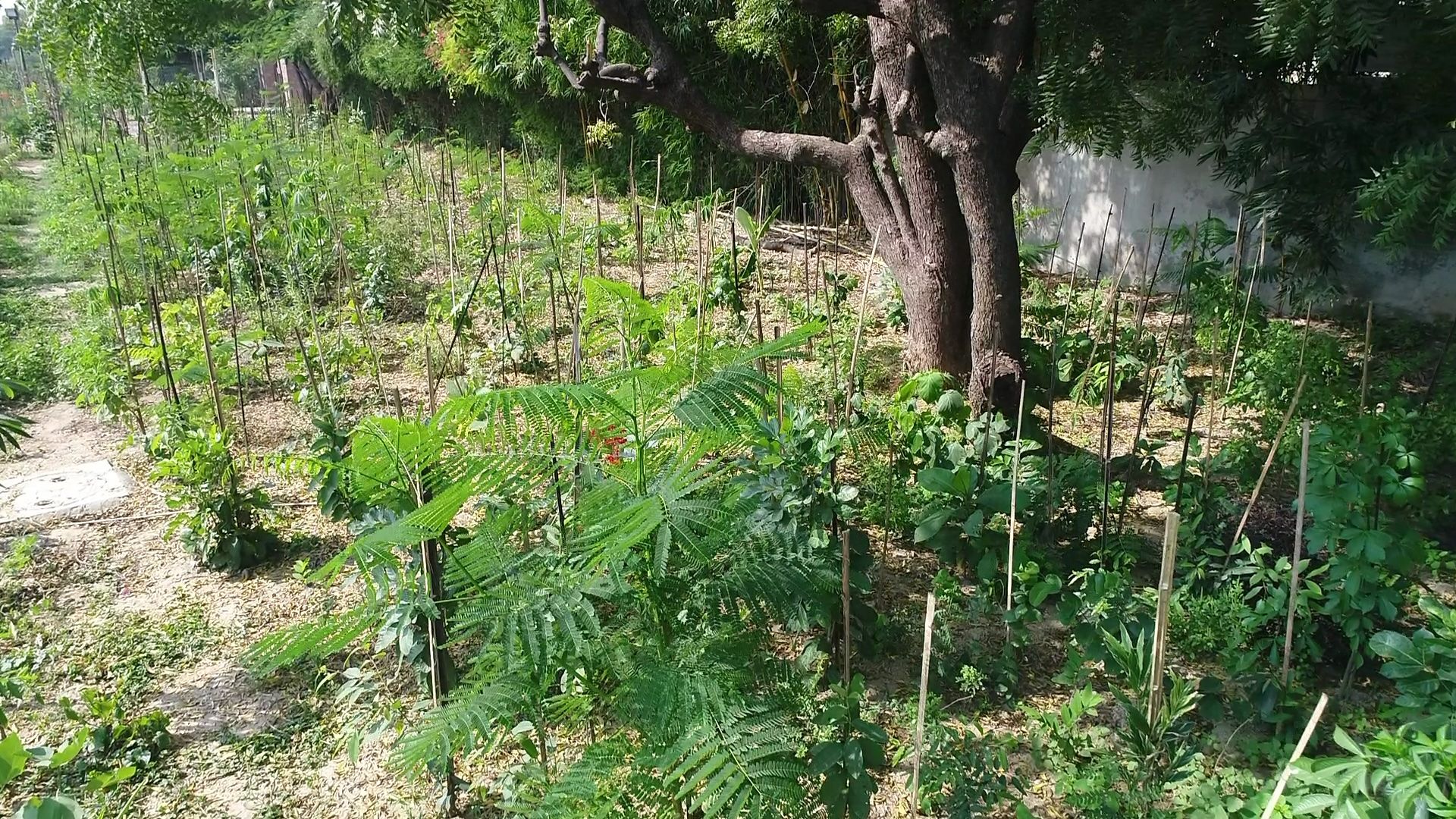
A CSR team can do everything right on paper — secure land, allocate budget, hire a vendor — and still end up with a plantation that dies within two years. In most cases, the failure starts with species selection.
The majority of tree plantation projects in India use a short list of species chosen for availability, not suitability. Neem, pipal, gulmohar, and a few ornamentals get repeated across sites with different soils, climates, and water regimes. The result is predictable: 40-60% mortality, low biodiversity, weak carbon sequestration, and audit reports that look better than the ground truth.
This article explains why species selection is the highest-leverage decision in a CSR afforestation project — and how Gardenia's 616-species native library turns that decision from guesswork into a repeatable system.
What the 616-species library contains
Gardenia's species library is not a list of names. It is a decision-support database built for afforestation planning. Each entry includes:
- Scientific and common names — including accepted names and known synonyms to avoid duplicates.
- Growth habit — tree, shrub, climber, herb, palm, bamboo — which determines vertical layer placement.
- Native range and origin — whether the species is indigenous to India and to which bioclimatic zone.
- Soil preference — clay, loam, sand, rocky, saline, alkaline, waterlogged, or well-drained.
- Tolerance — drought, flood, shade, wind, and pollution tolerance levels.
- Ecological use — timber, fodder, fuel, fibre, medicine, nectar, fruit, nitrogen fixation, or soil binding.
- Flowering and fruiting calendar — month-by-month phenology for pollinator support and seasonal planning.
- Conservation status — IUCN Red List category where available, plus state-level rarity notes.
The library draws on IUCN, GBIF, Wikipedia, and local botanical sources. It is updated as new species are validated and as site data from Gardenia's projects feeds back into the selection model.
Native polyculture vs. monoculture
A conventional CSR plantation often uses 5-10 species, sometimes fewer. A Miyawaki plantation at Gardenia uses 30-100+ species in a single acre. The difference is not cosmetic. It is ecological.
A monoculture or low-diversity stand is vulnerable. One pest, one disease, one drought event, or one wrong season can wipe out a large share of the plantation. There is no redundancy. There is also little habitat value — birds, insects, and soil organisms need structural and nutritional diversity to establish.
A native polyculture functions as a system. Fast-growing canopy species provide shade and wind protection for slower species. Nitrogen-fixing species improve soil for neighbours. Deep-rooted species access water that shallow-rooted species cannot. Fruiting and flowering species provide food across the year, supporting pollinators and seed dispersers.
The result is a plantation that is more resilient, more biodiverse, and more credible when reported to a board or auditor. It is also more likely to satisfy the Green Credit Programme's 5-year survival and 40% canopy density requirements.
Matching species to site conditions
Before any species is selected, Gardenia characterises the site. Soil tests measure pH, organic carbon, nitrogen, phosphorus, potassium, and texture. Water availability is assessed through rainfall data, groundwater depth, and irrigation access. The local climate, wind exposure, and existing vegetation are recorded.
Only then does the library get filtered. A saline site near the coast will pull from a different subset of species than a compacted urban plot or a degraded forest edge. A site with seasonal waterlogging will exclude drought-loving species. A windy ridge will prioritise wind-firm species with deep root systems.
This filtering produces a shortlist of 40-80 species that are ecologically appropriate for that specific location. From the shortlist, the planting matrix is built — typically 3-5 saplings per square metre across multiple layers, with densities varying by species role.
The process removes two common failure modes: planting species that cannot tolerate the site's conditions, and planting a single species that dominates the stand and collapses under stress.
Phenology: timing the planting calendar
Planting at the wrong time is a common cause of mortality. Saplings need time to root before heat or drought stress arrives. In Gujarat, that means aligning the main planting with the monsoon, but not all species respond to the monsoon in the same way.
The species library includes flowering and fruiting months for each entry. This lets Gardenia design a planting calendar that staggers species by their establishment needs and ensures that the plantation provides nectar, fruit, or seed across the year. It also helps predict when gap replacement should happen — typically after the first and second monsoon, when survival can be accurately assessed.
Phenology data is also useful for CSR reporting. A plantation that flowers in March and fruits in June produces observable, photographable outcomes at different points in the year. That matters for board updates, stakeholder communications, and social media — but more importantly, it indicates a functioning ecosystem.
Conservation status and audit value
Conservation status is not just a biodiversity concern — it is an audit and credibility concern. A CSR plantation that includes locally rare or threatened native species demonstrates intent beyond tree counting. It also reduces the risk of using invasive or ecologically inappropriate species that regulators and environmental groups may question.
Gardenia's library flags IUCN categories and state-level rarity. Where appropriate, the planting matrix includes species that are native, locally adapted, and not flagged as invasive. The species list becomes part of the compliance documentation pack: a defensible record of what was planted, why it was chosen, and what ecological role it performs.
For companies filing BRSR Principle 6 disclosures, this documentation feeds directly into environmental impact reporting. For companies pursuing Green Credits, it supports the survival and biodiversity evidence required after five years.
How Gardenia uses the library in practice
The library is not theoretical. It was used to design the planting matrix for the 5.1-acre SPEC India Miyawaki plantation in Makarba, Gujarat. That project used 200+ species from the library, selected for the site's soil, water, and climate conditions. Read the full case study.
The process for each Gardenia project follows the same sequence:
- Site assessment — soil tests, water audit, climate review, existing vegetation survey.
- Library filtering — select species that match the site's constraints and the project's ecological goals.
- Matrix design — assign species to canopy, sub-canopy, shrub, herb, and ground cover layers at Miyawaki density.
- Seasonal scheduling — align planting with monsoon and species-specific establishment windows.
- Documentation — record species list, source, rationale, and expected outcomes for CSR reporting.
- Monitoring — track survival, growth, and gap replacement across 24 months.
This is how a CSR plantation moves from a vendor's promise to a documented, measurable outcome. The species library is the operating system that makes it repeatable. The full 5-step methodology is documented separately.
If your CSR team is evaluating afforestation vendors, ask one question before anything else: How do you choose which species to plant? The quality of the answer will tell you most of what you need to know.
See the library in action
Gardenia's 616-species library is the foundation of every plantation we design. If you want to understand which species would work on your CSR site, request a site-specific planting plan.
Request a proposal