
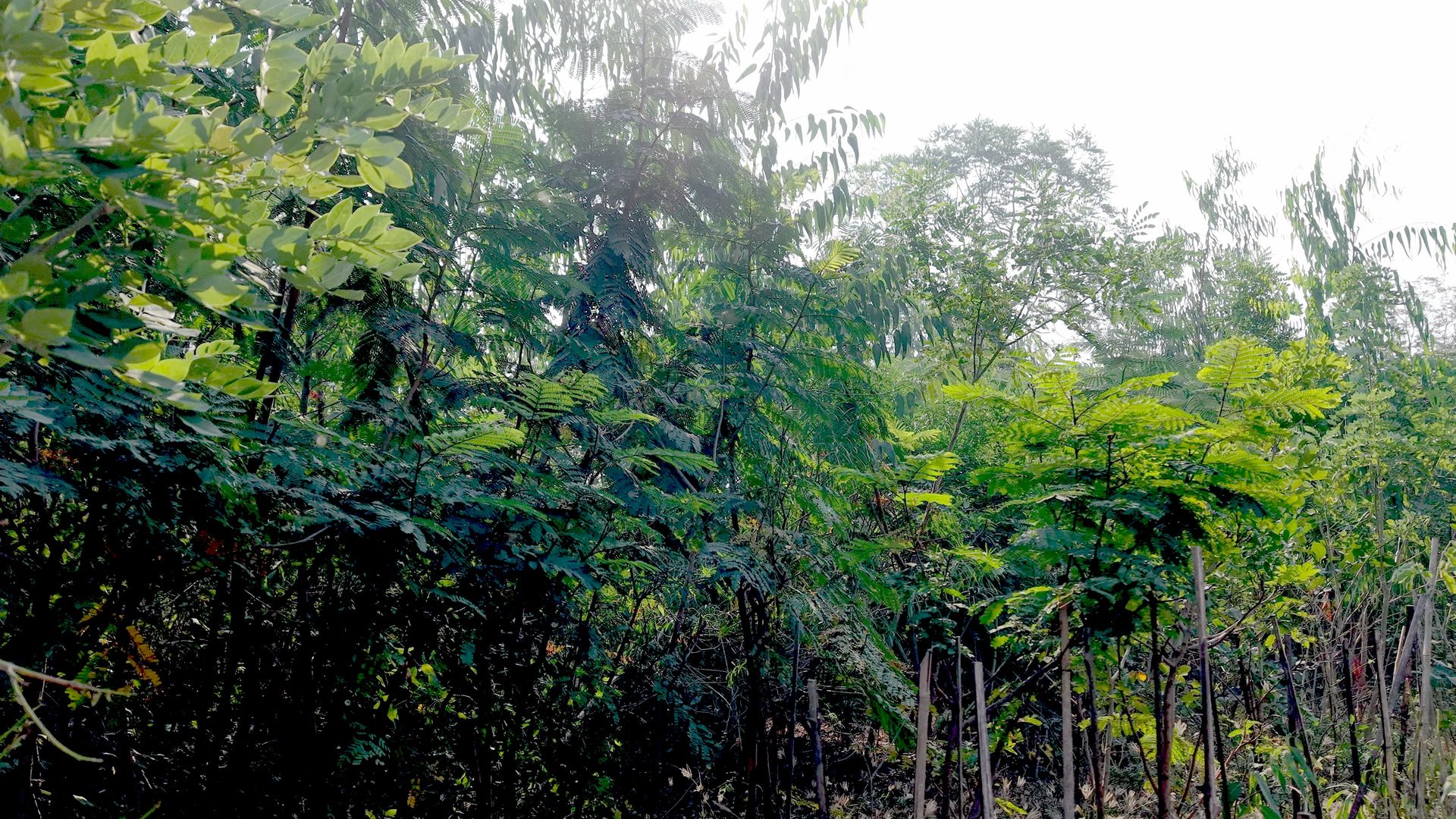
A World Environment Day plantation looks like this: employees in branded t-shirts, a row of saplings, a photographer, a press release. Two years later, the same site looks like this: dry grass, dead saplings, and no canopy. The CSR report says "5,000 trees planted." The ground says otherwise.
This isn't an indictment of CSR. It's a design problem. Tree plantations fail not because companies don't care, but because the project is designed as an event rather than a multi-year programme. This article is about how to fix that — using survival data from real projects, maintenance design principles, and monitoring systems that make failure visible before it's irreversible.
The ghost plantation problem
The term "ghost plantation" describes a site where trees were planted for a CSR event but died within 1-2 years. The site appears in CSR annual reports as "trees planted," but no forest exists on the ground. The gap between reported and actual survival is the dark matter of CSR afforestation — invisible in reports, obvious on site.
The scale of the problem is significant. Multiple studies and government audits have documented survival rates of 30-45% for government-led plantations and 50-60% for conventional CSR plantations at 2 years. At those rates, a "10,000 trees planted" CSR event produces 4,000-6,000 surviving trees — and that's before accounting for Years 3-5, when mortality continues without maintenance.
A 2025 academic review of Miyawaki plantations globally raised a separate concern: many published survival claims lack methodological rigour, with short monitoring windows and no independent verification. The review didn't conclude that Miyawaki doesn't work — it concluded that the evidence base is thinner than the claims. This matters for CSR teams because it means you can't take a vendor's survival number at face value. You need to see the methodology behind the count: how many trees were tracked, over what period, by whom, and with what verification.
The 2025 Green Credit Programme revision was designed to address this directly. Credits are no longer issued at planting — they're issued after 5 years of verified survival with 40% canopy density. This shifts the burden of proof from "we planted trees" to "the trees are alive and the canopy is closed." For CSR teams, this means the photo-op era is ending. The documentation era has begun.
Why plantations fail: five structural causes
Plantation failure is rarely caused by a single factor. It's a combination of design decisions made before planting and maintenance decisions made — or not made — after. Here are the five most common causes:
1. No maintenance budget.
The most common cause. CSR budgets cover planting (Year 1) but not maintenance (Years 2-5). Without watering, weeding, and gap replacement, saplings die in the first dry season after planting. This is a budgeting failure, not an ecological one.
2. Wrong species for the site.
Species selected for fast growth or appearance rather than site suitability. Eucalyptus on dry degraded land. Ornamental species in rural sites. Non-native species that can't handle local temperature extremes. The trees either die or survive without contributing to biodiversity.
3. No grazing protection.
On rural sites, unprotected saplings are eaten by livestock within weeks. Fencing, bio-barriers, or community agreements are essential. A plantation without grazing protection in a rural area is a plantation that will fail.
4. Inadequate soil preparation.
Degraded land has compacted, nutrient-poor soil. Without decompaction, organic matter addition, and proper pit preparation, saplings can't establish root systems. Miyawaki's soil preparation — biomass, cocopeat, and organic amendments — is what enables 30x density planting to work.
5. No monitoring or course correction.
Without monitoring, mortality is invisible until it's too late. A quarterly survival count catches problems when gap replacement is still possible. An annual count — or no count at all — means you discover the failure in Year 3, when the dead trees are beyond replacement.
What real survival data looks like
Survival rates aren't abstract numbers — they're site-specific, method-specific, and maintenance-dependent. Here's what the data shows from real Indian projects:
| Project | Method | Survival at 2 yrs | Key factor |
|---|---|---|---|
| SGSITS Indore | Miyawaki | 90% | 5-year maintenance (HDFC CSR) |
| IIT Kanpur | Miyawaki | 85%+ | Rs 36 lakh budget (Bajaj Electricals) |
| LT Finance Maharashtra | Miyawaki | 90.3% | Documented survival audit |
| Gardenia / SPEC India (Makarba) | Miyawaki | 90%+ | 24-month maintenance, gap replacement |
| Typical conventional CSR | Conventional | 50-60% | No maintenance budget |
| Government drives (average) | Conventional | 30-45% | No maintenance, no monitoring |
The pattern is clear: survival rate correlates with maintenance budget and monitoring quality, not with the number of trees planted. The projects that achieve 85%+ survival all have one thing in common — they were designed as multi-year programmes, not one-day events.
The Gardenia SPEC India project in Makarba, Gujarat, is a useful case study. 5.1 acres, 92,000+ plants, 360+ native species and varieties. The 90%+ survival rate wasn't achieved by planting — it was achieved by 24 months of active maintenance: watering, weeding, mulching, and gap replacement through two monsoon cycles. Read the full case study.
Designing for survival: maintenance as infrastructure
Maintenance is not an add-on — it's the core infrastructure of a plantation project. Here's what a maintenance plan should cover, by year:
Year 1: Establishment
Weekly watering (daily in summer months), weeding around each sapling, mulching to retain soil moisture, staking for wind protection, and pest monitoring. First survival count at Month 6. Gap replacement at Month 8-10 for any mortality in the first monsoon.
Year 2: Consolidation
Reduced watering frequency (every 2-3 weeks depending on rainfall), continued weeding, second gap replacement after the second monsoon. The second monsoon is critical — saplings that survive two monsoon cycles are statistically likely to survive to Year 5. Survival count at Month 18.
Year 3: Transition
Watering only during dry spells. Weeding reduces as canopy begins to close and shade out competitors. By end of Year 3, the closed canopy retains soil moisture and suppresses weeds — active maintenance ends. Survival count at Month 30.
Years 4-5: Monitoring
Active maintenance ends. The plantation operates without intervention. Monitoring continues — annual survival counts, canopy density measurements, and photographic documentation. This is the data that feeds BRSR Principle 6 reporting and GCP verification at Year 5.
The total cost of maintenance over 5 years is typically Rs 8-12 lakh per acre for Miyawaki — less than the establishment cost, but non-negotiable. Skip it, and the establishment cost is wasted.
Monitoring systems that catch failure early
Monitoring is not about reporting — it's about course correction. A monitoring system that only produces a year-end report is a monitoring system that discovers failure too late to fix it. Effective monitoring catches problems when gap replacement is still possible.
A monitoring system for a CSR plantation should include:
- Baseline data: geotagged plantation boundaries, per-plot or per-tree GPS coordinates, species list, and planting date — captured at planting.
- Quarterly survival counts: physical counts for small sites, drone imagery for larger sites. Each count produces a survival percentage and identifies areas of high mortality for targeted gap replacement.
- Canopy density measurement: drone or satellite imagery at least once per year from Year 2 onward. Canopy density is the GCP's key metric — 40% at Year 5 is the threshold for credit issuance.
- Photographic evidence: fixed-point photographs from the same location and angle at each monitoring visit. This creates a visual time series that shows growth progression — or the lack of it.
- Annual monitoring report: structured for BRSR Principle 6 disclosure, including survival rate, species-level tracking, canopy density, and carbon sequestration estimates.
If your implementation partner can't produce this level of monitoring, you have a vendor problem. Read our 12-point vendor checklist for what to look for.
Community stewardship: the cheapest survival strategy
On rural sites, the local community is the single most effective survival protection — and the cheapest. A village that sees the plantation as "ours" will protect it from grazing, fire, and encroachment. A village that sees it as "the company's project" will not.
Effective community stewardship strategies include:
- Local hiring: employ community members for planting, watering, and maintenance. This creates direct economic benefit and ensures someone is on-site daily.
- Benefit-sharing: design the plantation with species that produce fodder, fuelwood, fruit, or timber that the community can harvest sustainably. Agroforestry models are particularly effective here.
- Grazing agreements: formal agreements with local pastoralists on grazing boundaries, or provision of alternative fodder during the establishment period.
- Education: involve local schools in monitoring — students can conduct survival counts as a science activity, creating both data and community investment.
Community stewardship is not a CSR box to tick. It's a survival strategy. A plantation with community buy-in costs less to maintain and survives longer than one protected by fencing alone. When the community has a stake in the outcome — through employment, produce, or pride of ownership — the plantation has 365-day-a-year protection that no contractor can match.
The flip side: a plantation imposed on a community without consultation or benefit-sharing will be actively undermined. Saplings will be trampled by livestock, young trees cut for fuelwood, and irrigation infrastructure damaged. This is not malice — it's rational behaviour when the land produces no value for the people who live next to it. The CSR team that doesn't invest in community engagement is paying for maintenance that will be undone by the very people who could have been its strongest protectors.
Inspection-ready documentation: making survival auditable
The BRSR Core framework (FY 2026-27) requires reasonable assurance for environmental disclosures. This means your afforestation data must be auditable — not just self-reported. An auditor must be able to visit the site, compare it to the documentation, and conclude that the data is fairly stated.
Inspection-ready documentation means:
- Geotagged plantation boundaries visible on a map — the auditor can find the site.
- Per-tree or per-plot GPS coordinates — the auditor can find specific trees.
- Baseline species list with scientific names — the auditor can verify what was planted.
- Quarterly survival counts with photographic evidence — the auditor can verify the trend.
- Canopy density measurements from drone or satellite imagery — the auditor can verify the GCP metric.
- Annual monitoring reports structured for BRSR Principle 6 — the auditor can map data to disclosure requirements.
If your implementation partner produces a "certificate of plantation" rather than this level of documentation, the certificate is not worth the paper it's printed on. Reasonable assurance requires evidence, not certificates.
The cost of failure vs. the cost of success
A conventional CSR plantation costs Rs 2-5 lakh per acre for establishment. With 50% survival at 2 years, the cost per surviving tree is high — and the CSR report shows 5,000 trees planted when 2,500 are alive. The hidden cost: 5 years of Section 135 compliance with no measurable outcome, no BRSR data that withstands assurance, and no Green Credits.
A Miyawaki plantation costs Rs 15-25 lakh per acre for establishment plus Rs 8-12 lakh for 5 years of maintenance. With 90%+ survival, the cost per surviving tree is competitive — and the CSR report shows measurable outcomes, BRSR-ready data, and GCP eligibility.
| Factor | Conventional (no maintenance) | Miyawaki (5-year programme) |
|---|---|---|
| 5-year cost per acre | Rs 4-9 lakh | Rs 23-37 lakh |
| Survival at 5 years | 30-40% | 80-90%+ |
| Cost per surviving tree | Higher (fewer survivors, lower cost) | Lower (more survivors, higher cost) |
| BRSR-ready data | No (no monitoring) | Yes (digital monitoring) |
| GCP eligible | No (survival too low) | Yes (native species, 40%+ canopy) |
| CSR report value | "Trees planted" (no survival data) | "Trees surviving" (auditable) |
The choice isn't between cheap and expensive. It's between a project that produces a photograph and a project that produces a forest. The 2025 GCP rules, BRSR reasonable assurance, and growing scrutiny of CSR greenwashing all point in the same direction: the photo-op era is over. The companies that adapt first will have the strongest compliance stories and the most credible environmental disclosures.
There's also a reputational dimension. Journalists, NGOs, and ESG rating agencies are increasingly scrutinising CSR afforestation claims. A plantation that can be visited, verified, and photographed — with canopy closure and documented survival — strengthens your company's sustainability narrative. A ghost plantation that can be exposed by a site visit weakens it. In an era of mandatory BRSR disclosures and reasonable assurance, the gap between what you report and what's on the ground will be audited. Designing for survival from the start is the cheapest way to ensure that audit passes.
If you're ready to design a plantation project that survives — not just plants — talk to us. We'll walk you through the maintenance plan, monitoring system, and documentation that make survival auditable. See our partnership models for CSR deployment.
Designing a CSR plantation that needs to survive?
We build 5-year maintenance and monitoring into every project. Survival data, canopy measurements, and BRSR-ready documentation — from day one.
Request a ProposalFrequently asked questions
What is the survival rate of CSR tree plantations in India?
Conventional CSR tree plantations in India typically achieve 50-60% survival at 2 years, with government-led drives as low as 30-45%. Miyawaki plantations with proper maintenance achieve 85-95% survival at 2 years. The difference is almost entirely due to maintenance quality, species selection, and site preparation — not the planting event itself.
What is a ghost plantation?
A ghost plantation is a site where trees were planted for a CSR event but died within 1-2 years due to lack of maintenance, watering, or protection from grazing. The site appears in CSR reports as trees planted, but no forest exists on the ground. The 2025 Green Credit Programme rules were designed to address this by requiring 5-year verified survival before credits are issued.
How long does a Miyawaki plantation need maintenance?
Miyawaki plantations need 2-3 years of active maintenance — watering, weeding, mulching, and gap replacement — before the canopy closes enough to function without intervention. After Year 3, the closed canopy suppresses weeds and retains soil moisture. However, monitoring should continue through Year 5 for Green Credit Programme compliance and BRSR reporting.
How do you prevent grazing damage in CSR plantations?
Effective strategies include: physical fencing (chain-link or bio-fencing with thorny species), community engagement (hiring local guards, benefit-sharing with nearby villages), trenching around the perimeter, and selecting species that are unpalatable to livestock for the outer rows. For urban sites, grazing is less of an issue. For rural sites, community buy-in is the most sustainable protection.