
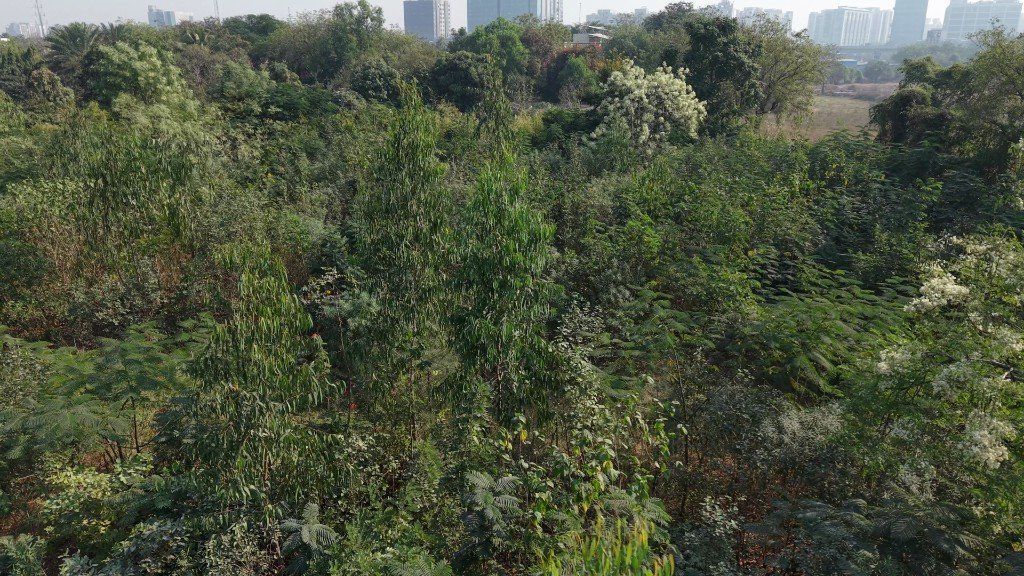
Ahmedabad is one of the hardest climates in India to grow a forest in — 42°C summers, eleven dry months, and soils that range from heavy clay to degraded fill. It is also where our reference forest stands: 3.35 acres at Makarba, 60,000+ plants, 200+ native species, 90%+ documented survival. Here is what an Ahmedabad Miyawaki project actually involves — cost, species, and timeline.
Every number below comes from project data on the ground in Gujarat, not from national averages transplanted onto a city they don't fit. For the full methodology behind these figures, see our Miyawaki in Ahmedabad page and the step-by-step method guide.
Why Ahmedabad is a special case
Most Miyawaki guidance in India is written for Kerala, Karnataka, or the Himalayan foothills — climates where rain does half the establishment work. Ahmedabad is different in three ways that decide project outcomes:
- Extreme heat load. Summer peaks above 42°C with long dry spells. Saplings planted without heat-adapted species selection and mulch strategy cook in their first summer.
- A single rainfall pulse. Nearly all annual rain arrives in one monsoon. Water systems must bank that pulse — capture, infiltration, and runoff management — or irrigation costs stay high for years.
- Difficult urban soils. Much of Ahmedabad's plantable land is compacted construction fill or saline-affected edge soil. Soil rehabilitation is not optional here; it is the difference between 90% survival and 40%.
These constraints are why our species library and maintenance window are tuned to Gujarat specifically — and why we can document survival numbers that generic vendors in other climates cannot match here.
What a Miyawaki forest costs in Ahmedabad
Ahmedabad project costs sit within the Gujarat ranges: roughly Rs 35–60 per square foot for establishment and Rs 5–8 per square foot per year for maintenance across years 2–5. On a per-acre basis, that is Rs 15–25 lakh establishment and Rs 2–3 lakh per year of maintenance — a full breakdown is in our Miyawaki cost guide.
For corporate and CSR projects, our engagement tiers start at pilot scale:
| Engagement tier | Investment range | Typical use |
|---|---|---|
| Pilot plot | Rs 1.5–5 lakh | Campus plots, first-phase validation |
| Standard CSR project | Rs 5–25 lakh | Full CSR-funded afforestation |
| Multi-acre programme | Rs 25 lakh+ | Multi-site, multi-year programmes |
Two Ahmedabad-specific cost drivers to budget honestly for: soil rehabilitation on urban fill sites (20–30% of establishment), and two full dry-season watering cycles — skipping either is the most common way projects fail here.
Species that survive Ahmedabad
The species list is the project. At Makarba we planted 200+ native species across two phases, drawn from our 616-species native library for Gujarat — the largest such curated palette in the state.
An Ahmedabad palette has to cover four ecological jobs at once: deep-rooted canopy species that punch through compacted layers and reach groundwater; drought-hardy sub-canopy and shrub layers that hold the understory through summer; nitrogen-fixing pioneers that rebuild depleted soil; and fruiting and flowering species that bring birds and pollinators — the agents that carry the forest into self-replacement.
What does not work here: water-hungry exotics planted for speed. They look good for one season, then become the maintenance burden and mortality statistics that undocumented projects prefer not to publish.
Timeline: month 0 to a self-sustaining forest
| Phase | When | What happens |
|---|---|---|
| Site analysis & design | Months −2 to 0 | Soil, water, and habitat survey; species palette and layout design |
| Soil rehabilitation | Month 0 | De-compaction, organic matter, microbial inputs, mulch |
| Planting | July (monsoon onset) | ~3,000 saplings per acre in randomized native polyculture |
| Maintenance window | Months 0–24 | Watering, mulching, replacement, weed control through two monsoon cycles |
| Establishment proof | Month 24 | Second-monsoon survival count — the number that matters |
| Self-sustaining forest | Year 3 onward | Natural regeneration, falling irrigation need, biodiversity arrival |
The visible transformation is fast: a Miyawaki stand in Ahmedabad reads as young woodland by year 2–3, because 30x planting density forces canopy competition from the first season. The invisible transformation — root depth and soil biology — is what the 24-month maintenance window exists to secure.
See it standing: the Makarba reference forest
Claims are cheap in afforestation; standing forests are not. Our reference site at Makarba, Ahmedabad is a 3.35-acre Miyawaki forest with 60,000+ plants across 200+ native species, planted in two phases (July 2023 and July 2024), holding 90%+ documented survival. The full story — with numbers, species, and documentation — is in our Makarba case study.
If you are evaluating vendors for an Ahmedabad project, visit Makarba. It is a short drive from anywhere in the city, and we host evaluation visits for CSR teams considering a project. Standing in a two-year-old forest answers questions that no proposal deck can.
How to start a project in Ahmedabad
The path from enquiry to planting is deliberately short:
- Site visit. We assess your plot — soil, water, sun, access — and confirm what the site can support.
- Proposal. A line-item estimate: establishment, five-year maintenance, monitoring, and reporting, with no hidden components.
- Planting season alignment. Gujarat planting targets July. Projects designed 2–3 months ahead of monsoon hit the window; projects designed in June wait a full year.
- Implementation and the 24-month window. We execute and maintain, with survival documented throughout for your ESG and CSR reporting.
For CSR teams, we implement as a direct vendor — GST invoice, Section 135 audit-ready documentation, no intermediary. Start with a proposal request or a Makarba visit.
Planning a forest in Ahmedabad?
Visit the Makarba reference forest or request a site-specific proposal — line-item costs, species plan, and 24-month maintenance included.
Request a ProposalFrequently asked questions
How much does a Miyawaki forest cost in Ahmedabad?
Roughly Rs 35-60 per square foot for establishment and Rs 5-8 per square foot per year for maintenance (years 2-5). CSR engagement tiers run from Rs 1.5-5 lakh pilot plots to Rs 25 lakh+ multi-acre programmes. Urban fill sites carry an additional soil-rehabilitation cost of 20-30% of establishment.
When is the right time to plant a Miyawaki forest in Ahmedabad?
July, at monsoon onset. Both phases of our Makarba forest were planted in July. Projects should be designed and soil-prepared 2-3 months ahead of the monsoon window; planting outside the window pushes establishment onto irrigation alone and raises mortality risk through the first summer.
How much land do I need for a Miyawaki forest?
The method works at surprisingly small scales — a few hundred square metres produces a functioning micro-forest, which is why pilot plots at Rs 1.5-5 lakh are a practical starting point for campuses and CSR programmes. Larger sites gain more ecological and carbon value, but density matters more than area.
Can we visit the Makarba Miyawaki forest?
Yes. Makarba is our reference site in Ahmedabad — 3.35 acres, 60,000+ plants, 200+ native species, 90%+ documented survival across two phases. We host evaluation visits for CSR teams and institutional buyers. Contact us to fix a date; it is a short drive from anywhere in Ahmedabad.